
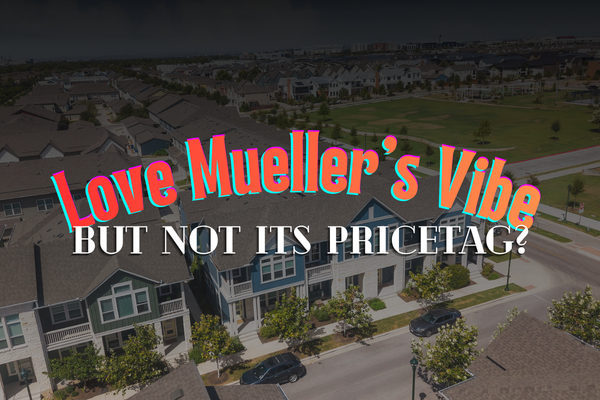
Love Mueller’s Vibe But Not Its Price Tag?
Here Are Some Other Austin Neighborhoods You Should Definitely Check Out
If you love Mueller but can't make the numbers work, central Austin has more options close by than most buyers expect.
I've lived in Austin since 1982 and have spent nearly 15 years helping people buy and sell homes here. The change I think about most is cost. I've watched rising home prices push people away from the parts of Austin they love.
Almost nobody walks into a buyer consultation hoping to live as far from Austin as possible. People want to stay close to work and to all the little places that make Austin feel like Austin. They also need a home that fits their budget and the way they live.
Helping buyers find that balance is one of my favorite parts of being a Realtor.
Start With What You Love About Mueller
Mueller wins people over with its lifestyle. You get parks and trails tucked between the homes and a real sense of community, all in a remarkable central Austin location. Neighbors gather at spots like Girard Kinney Park at Mueller, and plenty of daily errands happen on foot.
That lifestyle carries a price tag. Mueller single-family homes closed at a median of $962,360 in September 2026, which I covered in What I'm Seeing in the Mueller Market Right Now. Across the City of Austin, the September median was $570,958, according to the Unlock MLS September 2026 Central Texas Housing Report. For a lot of buyers, Mueller simply isn't financially realistic.
When someone tells me they love Mueller but can't find a home that fits their budget, I ask what exactly they love about it. Maybe it's walking to dinner or spending weekends in the parks. Maybe it's the neighbors, or just being close to downtown and everything happening in central Austin.
Those answers change where we look. Buyers who love walking to dinner might be happy in a neighborhood with a small commercial district nearby. Park and trail lovers have great options all over town, and my roundup of The Best Walking Trails in Austin is a good starting point. If you mostly want to stay near Mueller's amenities, some wonderful neighborhoods sit right around the corner.
That's when my mental map of Austin starts working overtime.
Windsor Park: Room to Breathe Next Door to Mueller
Windsor Park holds a special place for me because I used to live there. It's an established East Austin neighborhood right next to Mueller, with mature trees, neighborhood parks and its own branch library.
When my kids were little, we walked to the Windsor Park library. The bus routes were convenient too, which is something buyers rarely think about during a home search. Good transit can make a real difference in everyday life.
The neighborhood has kept evolving since I moved. The small commercial area around Hank's has grown into a gathering place where residents can walk to coffee and dinner. Dottie Jordan Park and an active neighborhood association anchor a community that has been building relationships for decades. Depending on your street, you might even walk into Mueller for H-E-B or tacos.
The price difference is what gets buyers' attention. In Windsor Park, you can often find a traditional single-family home with a yard for significantly less than a comparable property in Mueller. Trulia's estimates put the typical Windsor Park home value in the mid-$400,000s through the middle of 2026.
For someone who loves this part of Austin and needs a little more space, that trade-off is hard to ignore. I've always thought Windsor Park offers tremendous value, especially once you count everything beyond the house itself. If you're also weighing older homes closer to downtown, Mueller vs. East Austin: What You Really Get for the Price Difference breaks down what your budget buys in each.
Austin Has More Walkable Pockets Than You Might Think
Walkability looks different from one Austin neighborhood to the next. Mueller is unusual because its parks, businesses, homes and public spaces were planned together. In older neighborhoods, walkability tends to show up in smaller pockets.
North Loop is a great example. Charming bungalows and condos sit near a cluster of local shops and restaurants. You may only have a few blocks of businesses within walking distance, and those few blocks can add a lot to your daily life.
Crestview has a similar story. Its small commercial center keeps drawing buyers who are rediscovering how convenient it is to have neighborhood businesses close to home.
South Austin has changed dramatically over the years. I grew up in Western Trails, near Pack Saddle Pass, behind what is now Central Market on South Lamar. That Central Market used to be a mall, and I rode my bike there as a kid! Today the surrounding area is full of restaurants and shops that connect parts of Western Trails to everyday destinations more than people realize.
I also remember the stretch of Manchaca Road near Stassney from my childhood. It had a pawn shop and a rather unusual bookstore, among other things. Not exactly my dream destination as a 10-year-old. Today places like Quack's and Austin Java have turned that same general area into another little pocket of neighborhood activity.
Neighborhoods here never stop changing, and the places people overlook often have far more to offer than they expect. You'll find a few of them in The Best Up-and-Coming Austin Neighborhoods to Watch in 2026.
Sometimes the Answer Is a Different Kind of Home
The question that opens up the most possibilities is whether the type of home or its location matters more to you.
Some buyers need a yard and a traditional single-family house. Others would happily trade square footage to walk to their favorite coffee shop or live close to downtown.
If you're open to a condo, townhome or smaller bungalow, neighborhoods you assumed were out of reach may come back into play. I've watched buyers lock onto one property type so tightly that they miss homes offering more of the lifestyle they want. A smaller home in the right location often beats a bigger one with a long commute.
The key is figuring out which trade-offs you're genuinely comfortable making. Knowing your numbers early makes that easier, and I walk through it in What Can I Actually Afford, and How Do I Get Pre-Approved?
I've Lived in About 25 Austin ZIP Codes
I've got my own Ashley algorithm running whenever I sit down with a buyer. As we talk, I'm sorting through neighborhoods, housing types, commute patterns, parks, schools, restaurants and price points.
When someone mentions easy access to trails, I start thinking about parts of Southwest or Northwest Austin. A buyer who works in tech and wants established trees and a yard might send me toward Milwood. If you love Mueller's sense of community but need a more attainable single-family home, Windsor Park is the first place that comes to mind.
Living in so many Austin neighborhoods gives me a perspective that's hard to get from listings online. I know how different parts of the city feel. I've driven the commutes and watched commercial districts grow up around homes I know, and I've seen neighborhoods change over decades.
Nothing beats introducing someone to a place they never thought to explore. If you want to browse by lifestyle first, start with Austin Neighborhoods by Vibe: Which One Fits Your Life?
Your Austin Lifestyle Might Be Closer Than You Think
Keeping Austin's urban core accessible to more people matters deeply to me. I know how discouraging it feels when the neighborhood you love seems out of reach, and I also know this city has a lot of wonderful places to live.
Sometimes the right home is a few blocks past where you were looking. Other times it's in a neighborhood you've never visited, or it's a different kind of home than you pictured.
That's why I put so much emphasis on the buyer consultation. I want to understand what your everyday life looks like and what you want your next chapter to feel like before we tour a single house. I explain how that conversation works in The One Thing I Want Buyers to Do Before Touring Homes, and why the street matters as much as the floor plan in You Have to Like the Neighborhood - Not Just the House. When you're ready, reach out and we'll start there.
I might just introduce you to a part of Austin you'll wonder how you ever overlooked.
FAQ: Where Your Budget Goes Further Near Mueller
What neighborhoods near Mueller are more affordable?
Windsor Park sits right next to Mueller and often offers traditional single-family homes with yards for significantly less than comparable Mueller properties. North Loop and Crestview are other central Austin options with small, walkable commercial pockets.
How much do homes cost in Mueller right now?
In September 2026, Mueller single-family homes closed at a median of $962,360, and townhomes closed at a median of $887,500. The City of Austin median that month was $570,958, according to Unlock MLS.
Can you walk to Mueller from Windsor Park?
From parts of Windsor Park, yes. Depending on the street, residents can walk into Mueller for groceries at H-E-B or a meal out.
Why is Windsor Park considered a good value in Austin?
Buyers get an established East Austin neighborhood with mature trees, Dottie Jordan Park, a branch library and an active neighborhood association, plus easy access to Mueller. Homes there typically cost less than comparable properties in Mueller.
Which older Austin neighborhoods are walkable?
North Loop and Crestview both have small commercial districts close to homes. In South Austin, parts of Western Trails and the Manchaca Road area near Stassney have grown into walkable pockets with local restaurants and coffee shops.
Should I consider a condo or townhome to live closer to central Austin?
If location matters more to you than square footage, a condo, townhome or smaller bungalow can open up neighborhoods that might otherwise be out of reach. A buyer consultation helps you decide which trade-offs fit your life.